

How to Change Song Lyrics to a Different Language (Without Ruining the Song)
Changing a song's lyrics to a different language is not about direct translation; it's about lyrical recreation. A simple word-for-word swap can quickly ruin the melody and emotion that made you love the song in the first place. The key is to preserve the song's soul—its melody, rhythm, and feeling—while introducing new words that fit the original musical structure.
This process is more complex than a standard lyric change. It requires a full vocal production, not just a text translation, to ensure the new lyrics are not only meaningful but also perfectly singable.
Why Translating Song Lyrics Is So Difficult
Have you ever noticed how some songs cross borders and feel just as powerful in another language? That’s because they weren’t just translated; they were artistically adapted. The goal is to make the new lyrics sound as if they were written for the melody from the very beginning.
A great multilingual adaptation always puts the music first. This means matching the syllable count, respecting the original phrasing, and conveying the same emotional weight. It's a creative puzzle that software alone can't solve.
Machine Translation vs. Musical Adaptation
Let's be clear: running lyrics through a translation app will butcher a song. It’s designed for literal meaning, not musicality. A professional adaptation, on the other hand, is a creative process focused on making the new lyrics singable and emotionally resonant.
Here’s why one fails and the other succeeds:
| Aspect | Direct Translation (e.g., Google Translate) | Professional Musical Adaptation |
|---|---|---|
| Focus | Literal word-for-word meaning. | Emotional and melodic integrity. |
| Rhythm | Ignores syllable count and musical phrasing. | Matches new words to the original rhythm and meter. |
| Rhyme | Disregards rhyme schemes, leading to unpoetic results. | Recreates rhymes that feel natural in the new language. |
| Emotion | Fails to capture cultural nuances and emotional tone. | Adapts phrasing to convey the intended feeling. |
Understanding the pitfalls of word-for-word translation is the first step to avoiding a clunky, unsingable mess.
The global AI language translation market is booming, growing from $1.88 billion in 2023 to an expected $2.34 billion. But while these tools excel at text, they still can't handle the artistic demands of music. Rhythm, rhyme, and cultural subtext are just too complex. This is why the industry standard for high-stakes projects is a hybrid approach—combining human expertise with the best of technology.
Ultimately, adapting a song for a new language is an art form. It requires a deep respect for both the words and the music to create something that feels just as authentic and moving as the original.
How a Multilingual Lyric Change Actually Works
If you want to successfully change song lyrics to another language, you must treat the music as the blueprint. The melody dictates where every word, syllable, and emotional beat must land.
This process is not karaoke, a cover, or AI-generated music from scratch. It’s a human-led vocal production enhanced by tasteful AI voice-matching to preserve the magic of the original song. What makes this possible is a service that lets you change the lyrics of a song you already love while preserving the original instrumental, the original melody, and even the original singer’s voice. Your rewritten lyrics are heard in the original artist’s voice over the original track.
The professional workflow looks like this:
- Lyrics are rewritten into another language with musical intent. A professional lyricist fluent in the target language crafts new lyrics that match the original melody's syllable count, rhythm, and emotional flow.
- A real, fluent singer performs the lyrics. This is the crucial human step. A vocalist who is a native speaker performs the new lyrics, capturing the unique phrasing and feeling of the song.
- Engineers apply AI voice-matching. After the human performance is recorded, audio engineers use advanced AI to make the new vocal sound identical to the original artist’s voice.
- The track is professionally mixed. The new vocal is seamlessly blended with the original instrumental for a studio-quality finish.
This process ensures the new lyrics feel like they were there all along. If you're curious about the fundamentals of writing lyrics that truly serve a melody, our guide on songwriting tips for beginners is a great place to start.
Beyond Words: Recreating Emotion and Meaning
Professional lyric adaptation isn't just about making words fit—it's about making emotions translate. This demands a deep feel for cultural context, idioms, and all the subtle ways different languages convey feeling. A phrase that sounds romantic and poetic in one language might come across as clinical or just plain awkward in another, even if the literal translation is technically correct.
Research into song translation confirms this. One study on adapting popular songs found that direct, word-for-word translation almost never worked. Instead, the most successful technique by far was paraphrasing (used in 53% of cases), followed by adaptation and substitution. This tells you the goal isn't to replicate the words, but to capture the original intent and emotion. It’s a human-centric craft, as today's technology still can't quite grasp the musical and emotional nuances that a skilled translator handles by instinct. You can read the full research on lyric adaptation strategies to learn more.
A professional lyric change service lives and breathes this musical and emotional translation. It's a craft that involves:
- Syllabic Matching: Making sure the number of syllables in the new phrase lines up perfectly with the number of notes in the melody.
- Rhythmic Alignment: Placing stressed syllables on strong beats to keep the song’s groove and punch intact.
- Vowel Shaping: Choosing words with vowel sounds that are not only easy but also beautiful to sing, especially on long, held notes.
- Cultural Adaptation: Swapping out idioms or references that wouldn't land in the new culture for equivalents that spark the same feeling.
When you get it right, the result is a song that feels completely authentic—as if it were written in the new language from day one.
The Human-Led Process: Real-World Examples
So, how does a professional multilingual lyric change actually happen? It’s a detailed, human-led process that's part art, part science. The final product sounds seamless because it starts with real human talent.
This is the fundamental difference between a professional change song lyrics service and automated tools. While AI has its place in music, it's important to understand why AI music generators can't change lyrics effectively on their own. They just don't have the nuanced feel for melody, cultural context, and raw emotion that a human artist brings to the table.
This diagram breaks down the core musical constraints—melody, rhythm, and syllables—that guide the entire human-led process.
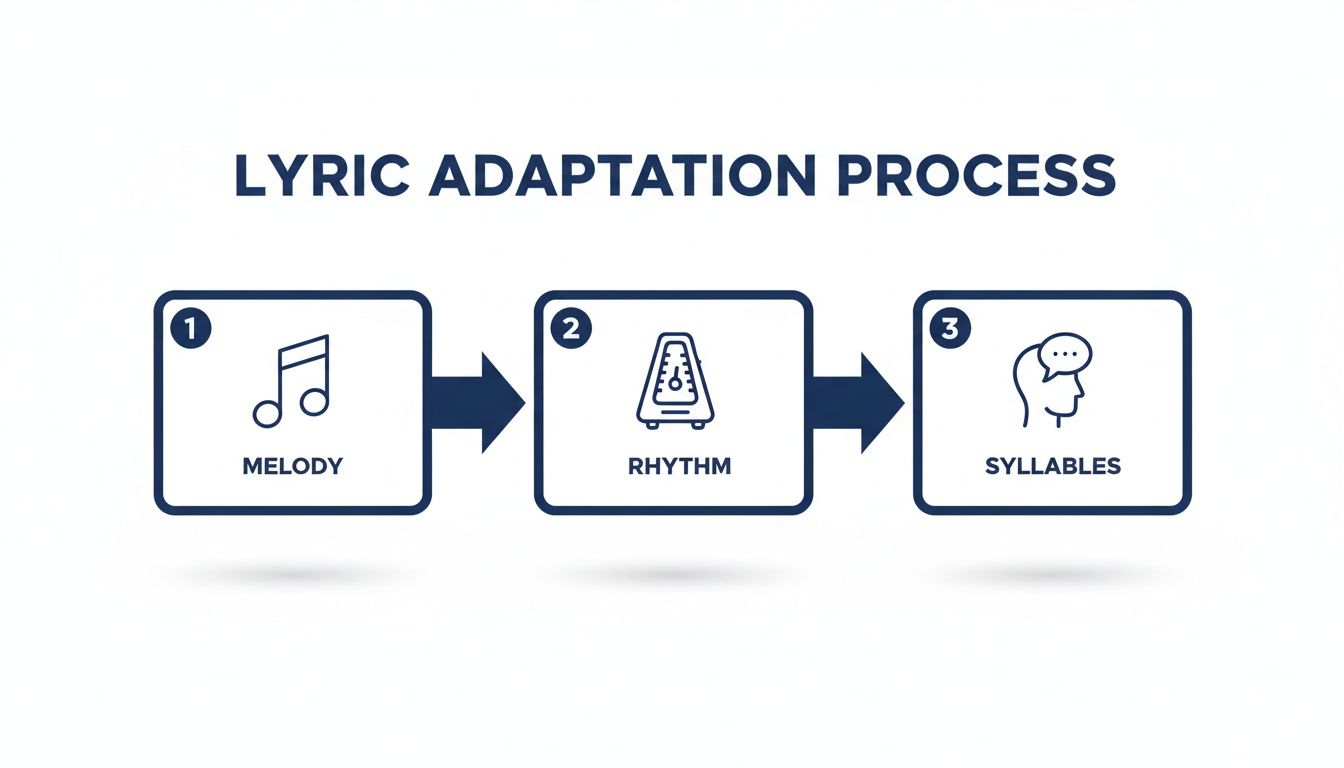
As you can see, every decision is dictated by the song's original musical structure. This ensures the final result feels organic and intentional, not forced.
Hearing the Difference in Practice
The result of this human-crafted, tech-enhanced process is a deeply personal song that sounds incredibly polished. You can hear the quality for yourself in some real-world examples.
Check out how Ed Sheeran's "Perfect" was transformed into a beautiful German tribute. The new lyrics flow flawlessly with the melody, and the voice is unmistakably Ed Sheeran's.
In this next one, Christina Perri's "A Thousand Years" was rewritten in French for a wedding. The emotional weight of the song is completely intact, delivered with stunning clarity in a new language.
These examples show what’s possible: a seamless, studio-quality finish that honors the original song while telling a completely new, personal story.
The key takeaway is that a flawless multilingual lyric change is not an automated task. It is a full-blown production that relies on the collaborative expertise of linguists, musicians, singers, and audio engineers.
This multi-layered approach ensures that nothing gets lost in translation. In fact, a new dimension of meaning is added, creating a powerful connection for listeners in any language.
Bringing International Stories to Life with Music

Sure, there’s a whole technical process behind adapting a song into another language. But what really drives someone to change song lyrics to another language is the desire for a real, human connection. It's about music becoming a bridge between cultures, a way to honor where you come from, and a medium to tell personal stories that resonate no matter what language you speak.
A familiar melody is a universal starting point. But when you weave in lyrics that are culturally and personally relevant, you create something unforgettable.
For Multilingual Weddings and Anniversaries
Picture a first dance. The couple comes from different backgrounds, different countries, different languages. Instead of picking one person's culture over the other, they dance to their song, with lyrics that flow seamlessly between both of their native tongues. It’s a powerful symbol of unity, made possible by rewriting a song to fit their unique story.
To Honor Family Heritage and Cultural Tributes
For many of us, our roots are a huge part of who we are. Taking a song that already holds special meaning for your family and rewriting it in a heritage language can be an incredibly moving experience. It’s a way to connect with older generations, keep cultural traditions alive, and create a modern heirloom that speaks to both the past and the present.
For International Brand Campaigns
When a business expands into a new market, success depends on cultural respect. Simply translating a jingle or brand anthem often falls completely flat. By adapting the lyrics of a brand song to fit the local culture, a company sends a much stronger message. The melody provides instant brand recognition, but the thoughtfully rewritten lyrics show a deep respect for the audience. This is where a professional change song lyrics service becomes a secret weapon for global marketing teams.
The real magic of a multilingual lyric change is its ability to make a globally recognized song feel intensely personal. The original melody is the common ground, and the new lyrics build a bridge to a specific culture, family, or moment in time.
The world of AI music is growing fast, but human artistry is still what makes these personalized experiences special. While some models can spot hit songs with up to 97% accuracy, this shows AI’s strength is in analyzing data, not generating genuine emotion. Plus, with purely AI-generated music, the copyright often belongs to the platform, not you. This highlights the value of a service where human creativity is the driving force, and AI is just a powerful tool. Discover more insights about AI music trends on botmemo.com.
Whether it’s for a wedding, a family tribute, or a global product launch, the goal is always the same: using the power of a familiar song to tell a new story that crosses borders and brings people closer.
Your Two Paths Forward: Learn or Delegate
So, you’re ready to adapt your song for a new language. You understand the creative and technical hurdles—now it's time to decide how you're going to tackle it. Fundamentally, you have two choices: learn the entire process yourself, or delegate it to a professional service.
Let's break them down so you can figure out which one makes the most sense for your project.
1. The Learning Path: For the Hands-On Creator
This is the DIY route, perfect for musicians, producers, or anyone who loves getting into the weeds. If you're comfortable in a Digital Audio Workstation (DAW), have some recording gear, and want to learn how lyric changes and AI voice models work, this path is for you.
Going this route is about mastering a new skill. The AI Music Academy is a great resource for learning the process yourself.
This path is probably your best bet if:
- You already have a background in music production or are excited to learn.
- You enjoy a technical challenge and want total creative control.
- You have the time to invest in learning, experimenting, and tweaking.
The satisfaction of pulling it off yourself is huge, but don't underestimate the time and effort it takes.
2. The Done-For-You Path: For a Guaranteed Result
What if you just want a studio-quality multilingual song without the steep learning curve? That’s where a professional change song lyrics service like AI Music Service comes in.
This option is built for convenience and peace of mind. AI Music Service handles everything, tapping into its global network of professional, native-speaking vocalists to find the perfect match for your song's genre, language, and style. Because multilingual lyric changes involve translation, vocal performance, and full production, they typically require more work than standard lyric changes, but a professional service ensures a flawless result.
The managed workflow includes:
- Expert Lyric Adaptation: A skilled linguist rewrites your lyrics to fit the melody.
- Professional Vocal Performance: A native-speaking singer records the new lyrics.
- Advanced Voice Matching: Engineers use AI to match the original artist's voice.
- Final Studio Mix: The track is professionally mixed for a radio-ready finish.
A professional service takes all the guesswork and technical frustration off your plate. You get a polished, powerful song that’s ready for your wedding, anniversary, or international brand campaign.
Ultimately, it comes down to what you value most. If you thrive on the process, the Learning Path offers an incredible challenge. But if your goal is a perfect final product with zero hassle, a professional done-for-you service is the clear winner.
Making Your Song Speak a New Language
You’ve seen what it takes to successfully change a song's lyrics to a different language. It’s a delicate craft that blends linguistic art with musical science—a process that needs real singers and expert engineers to get right.
The goal is never just to translate words; it's to translate a feeling. This requires a deep respect for how language and music work together to create an emotional impact.
From Understanding to Action
Whether you're excited to learn these skills yourself or you'd rather partner with a professional service for a studio-quality outcome, you now have a clear roadmap. You understand that syllable counts, rhyme schemes, and cultural nuances are everything. If you're looking for practical ways to blend language learning with music, resources that show you how to learn a new language through music can offer some fantastic strategies.
The core takeaway is this: A multilingual lyric change succeeds when it honors the music first. The new words must serve the original melody, not the other way around.
If the idea of a hands-on approach sparks your creativity, the learning path is wide open. But if your priority is a flawless, emotionally resonant final track without the steep learning curve, a professional lyric change service is your best bet.
The next step is yours. Think about a song you already love and imagine the powerful new story it could tell. When you’re ready to make it happen, our change song lyrics service is here to bring your vision to life.
Your Questions Answered
Adapting a song into a new language is a creative puzzle, and it's natural to have questions about how all the pieces fit together. Let's dig into some of the most common ones we get.
Can I Just Plug the Lyrics into an Online Translator?
That’s a definite no. While online translators are amazing for simple text, they just aren't built for music. They completely ignore melody, rhythm, syllable counts, and all the cultural nuances that make a song feel right.
You'll end up with clunky, unsingable phrases that sound emotionally tone-deaf. A true professional adaptation isn't a translation at all—it's a complete rewrite from the ground up, designed to capture the original song's soul while fitting the music perfectly.
Is This the Same Thing as an AI Cover Song?
Not at all. This is a totally different beast. An AI cover usually just takes the original song and uses a computer-generated voice to sing it.
Our lyric change service is a human-first process. It all starts with your new lyrics, which are then performed and recorded by a real, professional singer. Only after we have that authentic human performance do we use AI voice-matching technology to make it sound like the original artist. It's human artistry, supercharged by tech—not replaced by it.
How Do You Find a Singer Who's Fluent in My Target Language?
Great question. We’ve spent years building a global network of vetted, professional vocalists who are native speakers in dozens of languages.
When a project comes in, we hand-pick the right singer based on the specific language, the song's genre, and the original artist’s vocal style. This ensures the performance isn't just linguistically correct but also culturally and musically authentic, so the song connects with its new audience exactly as it should.
Ready to tell your story in a new language? AI Music Service combines human artistry with advanced technology to create unforgettable musical experiences. Start your project by visiting our page to change song lyrics today.


