

Changing Song Lyrics Into Another Language: What Actually Works (and What Doesn’t)
Changing song lyrics into another language isn't a simple copy-paste job. It’s a delicate act of musical and emotional adaptation. What works is a process that respects the song's original melody, rhythm, and soul. What fails, almost every time, is treating lyrics like a standard document—that’s a surefire way to get an awkward, unsingable mess.
The reality is that changing lyrics into another language is significantly harder than standard lyric changes. Direct translation tools often fail due to mismatched syllable counts, awkward phrasing, lost rhymes, and an inability to capture emotional delivery. The core challenge is preserving the original melody and vocal feel while introducing a new language.
The Unique Challenge of Multilingual Song Translation
Translating a song is so much more than running the lyrics through an app. The real challenge isn't just swapping words; it's about preserving the song's very essence—its melody, rhythm, syllable count, and emotional heart.
A direct, word-for-word translation might get the literal meaning across, but it completely ignores the music it's supposed to live in. A simple three-syllable phrase in English might balloon into seven syllables in Spanish, making it physically impossible to sing along to the original tune. This fundamental clash between language and music is where most translation attempts fall apart.
Why Literal Translation Fails
Think of a song as a perfectly crafted puzzle where each word and note fits snugly together. When you try to force translated words into that puzzle, the whole thing shatters. You end up with:
- Mismatched Syllables: The new lyrics either have too many or too few syllables per line, completely wrecking the song's natural flow.
- Awkward Phrasing: Sentences become clunky and unnatural because they're twisted into shapes they were never meant to take just to fit the timing.
- Lost Rhyme and Rhythm: The poetic glue that makes a song catchy and memorable often vanishes without a trace.
- Cultural Disconnect: Idioms, slang, and cultural references rarely translate one-to-one, leaving you with lyrics that are either confusing or just plain bland.
The difficulty of this process is often tangled up in cultural context and artistic expression. For a closer look at these kinds of complexities, diving into resources on understanding cultural nuances in AI book translation can offer some valuable parallels.
Success in a multilingual lyric change isn't measured by how accurately the words are translated, but by how authentically the new lyrics feel when sung to the original music.
To really grasp what we're up against, it helps to break down the specific hurdles that every artist and translator has to clear.
Key Challenges in Multilingual Lyric Changes
Here's a quick look at the main obstacles that can make or break a multilingual song adaptation. Getting any of these wrong can fundamentally alter the final product, turning a beloved hit into something unrecognizable.
| Challenge | Why It's Difficult | Impact of Failure |
|---|---|---|
| Syllable & Rhythm | Languages have different rhythmic patterns and syllable counts for similar concepts. | The new lyrics sound rushed or drawn out, completely breaking the song's natural cadence. |
| Emotional Tone | The emotional weight of a word in one language may not have a direct equivalent in another. | A heartfelt ballad can sound flat or unintentionally comical with the wrong word choice. |
| Rhyme & Poetics | Rhyme schemes and poetic devices are language-specific and rarely survive direct translation. | The song loses its artistic and memorable qualities, feeling more like a spoken statement. |
| Cultural Nuance | Idioms, metaphors, and cultural references lose their meaning when translated literally. | The lyrics can become confusing, bland, or even offensive to a new audience. |
Navigating these challenges requires more than just linguistic skill; it demands a deep musical intuition and a feel for the culture you're translating for. It’s an art form in itself.
Common Approaches That Often Fall Short
When the idea strikes to change song lyrics into another language, most people turn to a few common methods. While these options are easy to find, they usually trip up on the delicate mix of rhythm, meaning, and emotion that makes a song really connect with people. Knowing their weak spots is the first step toward finding a solution that actually works.
Getting this right is a balancing act, requiring a feel for musicality, a sharp cultural awareness, and a genuine emotional delivery.
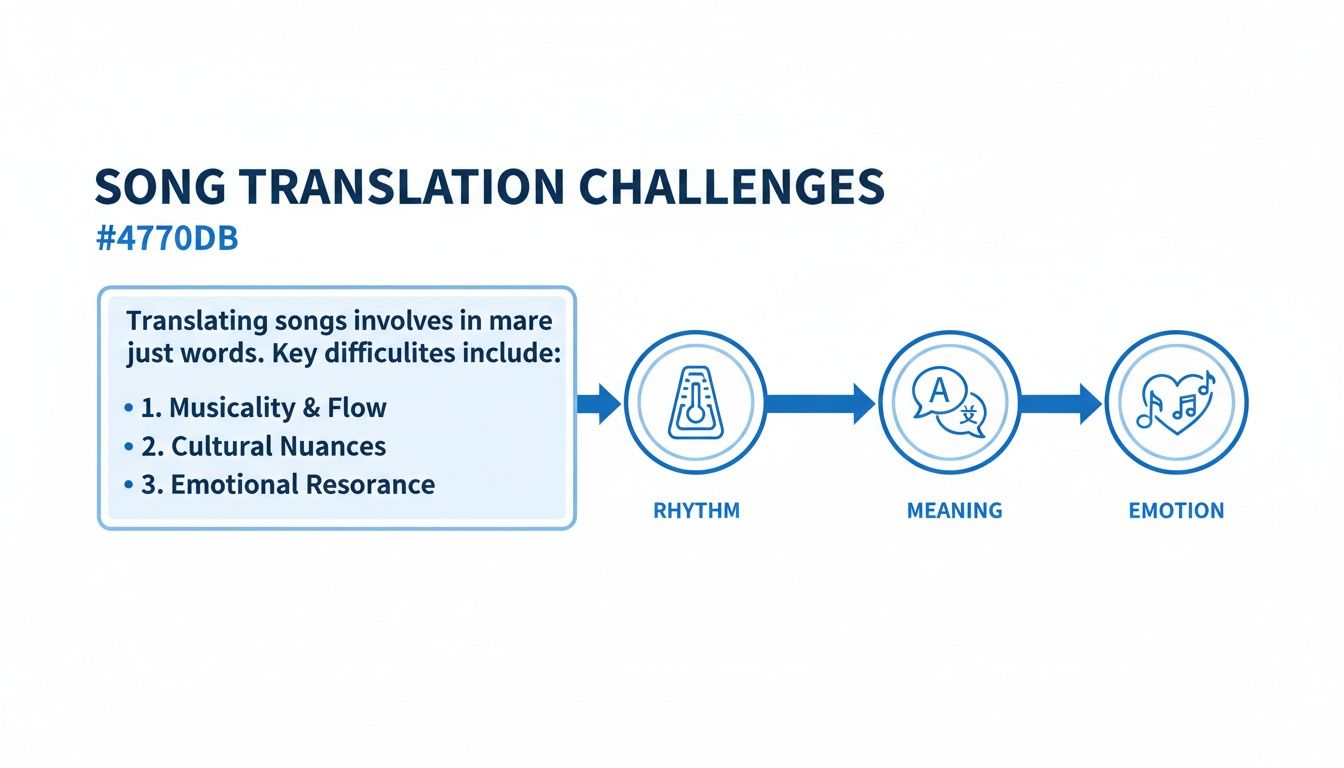
Successfully translating song lyrics means the new words have to fit the rhythm, get the original point across, and hit with the same emotional punch.
1. DIY Translation + Self-Recording
Going the hands-on route—translating the lyrics yourself and recording your own vocals—seems simple enough. But this path is littered with predictable traps that can tank the quality of your final track.
The main issues you'll run into are:
- Mismatched Syllables: Even if the words are a perfect translation, they often won't fit the song's melody. A one-syllable English word might blow up into a four-syllable word in Spanish, creating a clunky, unsingable mess.
- Non-Native Pronunciation: Unless you’re a native speaker, your performance will likely have an accent that feels off. This can break the listener's immersion and kill the song's emotional impact.
- Production Limitations: Without a professional studio, mic, and mixing software, your vocals will probably sound thin and disconnected from the high-quality instrumental. It ends up feeling more like karaoke than a polished song.
The DIY method gives you total creative control, but the technical and linguistic hurdles are usually just too high to clear for a professional-sounding result.
2. Automated or Template-Based Lyric Tools
Lately, a bunch of online tools have popped up claiming they can help adapt lyrics. While they might be handy for brainstorming or simple rewrites in the same language, they are not built for the complexity of changing lyrics into another language.
These automated systems struggle with multilingual lyric changes, vocal realism, and musical timing. They run on algorithms, not artistry, and that leads to some major failures. We get into more of this in our guide on why AI generators fail at changing song lyrics.
Automated tools can translate words, but they can't translate feeling. They miss the poetic and rhythmic subtleties that are essential for a song to connect emotionally.
These tools typically spit out lyrics with:
- Literal but Unmusical Translations: They focus on word-for-word accuracy over singability, leaving you with lyrics that are grammatically correct but a rhythmic disaster.
- Lack of Vocal Realism: The generated vocal performances often sound robotic and lack the emotional depth and unique style of the original artist.
- No Cultural Context: The software can't understand idioms, metaphors, or cultural references. It just replaces them with sterile, literal equivalents that strip the song of its soul.
3. Basic Lyric Change Services
Some services are great at rewriting lyrics but aren't necessarily set up for the unique challenge of a full language transition. They might be perfect for changing lyrics for a wedding or birthday in the song’s original language, but a multilingual project is a different ballgame.
These services can miss the mark because they often struggle with full language transitions, native pronunciation, and emotional authenticity. Their teams may lack:
- Native-Speaking Vocalists: They might not have a roster of professional singers who are fluent in your target language, so you might get a vocalist with a noticeable accent.
- Linguistic Adaptation Expertise: Their team might be full of skilled creative writers, but not experts in the art of musical adaptation—rewriting lyrics to fit a pre-existing melody and rhyme scheme in a new language.
- Advanced Vocal Production: To make the final product sound seamless, you need sophisticated audio engineering to blend the new vocals perfectly with the original instrumental. Without it, the track can sound like a disconnected cover.
While they're a step up from doing it yourself, these services often don't have the specialized resources to pull off a multilingual lyric change at a studio-quality level.
4. The Professional Method That Actually Works
So, how do you change song lyrics into another language and get a studio-quality result? The strongest outcomes come from a human-led workflow that combines linguistic expertise, real vocal talent, and advanced audio production. This is not karaoke, a standard cover, or AI-generated music from scratch. It is a full vocal production.
The goal is to create a seamless final track where your rewritten lyrics are heard in the original singer’s voice over the original instrumental.
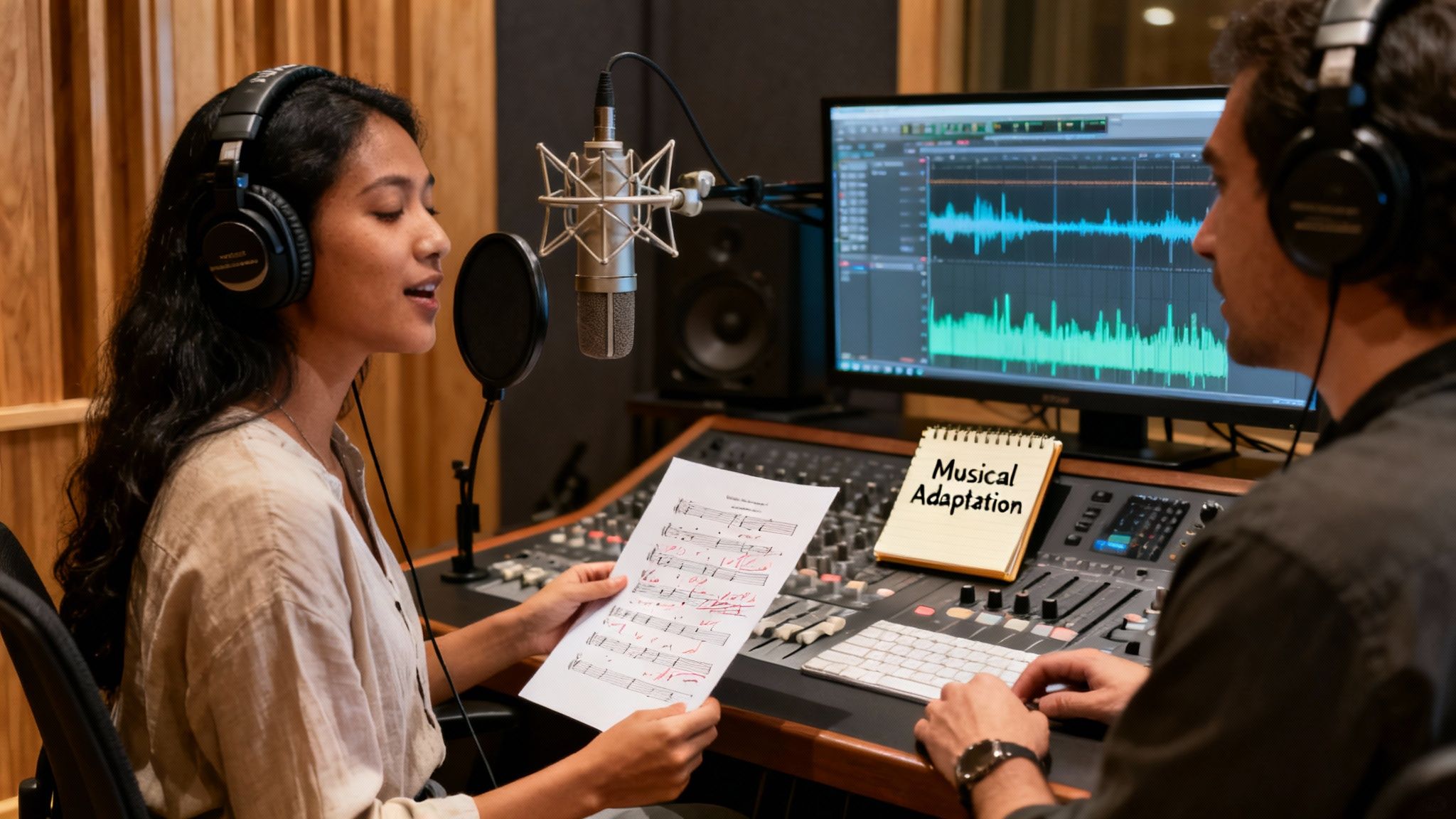
Lyrics Are Adapted Musically, Not Just Translated
The foundation of a great multilingual lyric change is throwing direct translation out the window. The real work begins with musical adaptation, where skilled linguists and songwriters team up to rewrite the lyrics, not just translate them.
They aim to capture the original message and feeling, but critically, they make sure the new words fit perfectly into the song’s existing structure. Every single line has to match:
- The original syllable count
- The rhythmic phrasing and cadence
- The rhyme scheme and poetic flow
A Real Singer Fluent in the Target Language Performs
Once the new lyrics are perfectly adapted, they go to a real, professional singer who is a native or fluent speaker of the target language. This is a non-negotiable step for an authentic result. A human performer brings an emotional depth and subtle nuance that technology simply can't fake.
The singer’s job isn't just to sing the notes; it's to perform the new lyrics by channeling the original artist's melody, timing, and emotional delivery. This ensures the pronunciation is flawless and the performance carries the same punch as the original.
Engineers Apply Voice-Matching So It Sounds Like the Original Singer
Here’s where human artistry and incredible technology meet. After a professional singer records the new vocals, audio engineers step in with advanced AI voice-matching software. This tech meticulously analyzes the new recording and reshapes its characteristics to sound like the original artist.
It's crucial to understand this isn't an AI-generated vocal from scratch. The AI is enhancing a real human performance, preserving all the emotion and nuance while matching the iconic vocal tone.
This is the secret sauce that makes the final track feel so seamless and genuine. For a deeper look at how this works, check out our guide on how to change song lyrics without ruining the voice.
The Track Is Mixed Over the Original Instrumental for a Seamless Result
The final step is bringing it all together. Professional audio engineers take the newly voice-matched vocal track and mix it flawlessly with the original instrumental. This means balancing levels, adding effects like reverb and delay to match the original production, and ensuring the new vocals sit perfectly in the track.
From there, the song is mastered to give it the same loudness, clarity, and punch as a commercial release. You get a polished, studio-quality track that sounds completely cohesive—not like a vocal just slapped on top of a backing track. This meticulous process is what separates a professional lyric change service from every other method out there.
Seeing The Professional Method In Action
It’s one thing to read about a professional process, but it’s another to actually hear the difference. When you change song lyrics for a new language, the real goal is to create something that feels completely natural—like the song was always meant to be sung that way. A human-led workflow nails this, sidestepping the cringey, awkward results you often get from amateur attempts.
From English to German: A Flawless Transition
Imagine taking an upbeat English pop song and making it a hit for a German audience. The tricky part isn't just translating the words; it's keeping the song’s original punch and energy while making the German lyrics sound like they belong. A professional service ensures every syllable, every beat, and every bit of emotion lines up just right.
Check out this example of how a popular track was completely transformed into German. Notice how the phrasing feels native to the language, not clunky or forced, all while keeping the original artist's vocal style.
From English to French: Capturing Emotional Nuance
Now, let's think about a heartfelt ballad. So much of its power comes from the subtle delivery and emotional weight of each line. A direct, literal translation would completely flatten that nuance. But a thoughtful musical adaptation into French can preserve—and sometimes even deepen—its romantic or somber feel.
This next example shows a beautiful transition into French. Listen closely to the authentic pronunciation and the emotional delivery that makes this version just as moving as the original. This is the level of quality a professional change song lyrics service aims for.
A great multilingual lyric change should be invisible. The listener shouldn’t hear the process—they should just hear a beautiful song in their own language.
What makes these examples work is a deep respect for both the original song and the new language, brought to life by human talent and polished with technology. Each one tells a unique story, whether it's for a couple wanting their first dance song in their native tongue or a brand looking to connect with a global audience. For more proof of how this all comes together, feel free to explore our other song lyric change examples.
Choosing Your Path: DIY Learning vs. A Done-For-You Service
When you decide to change song lyrics into another language, you’re faced with a choice. Do you roll up your sleeves and learn how to do it yourself, or do you bring in a professional service to guarantee a studio-quality result? The right answer comes down to your goals, your budget, and how comfortable you are with music technology.
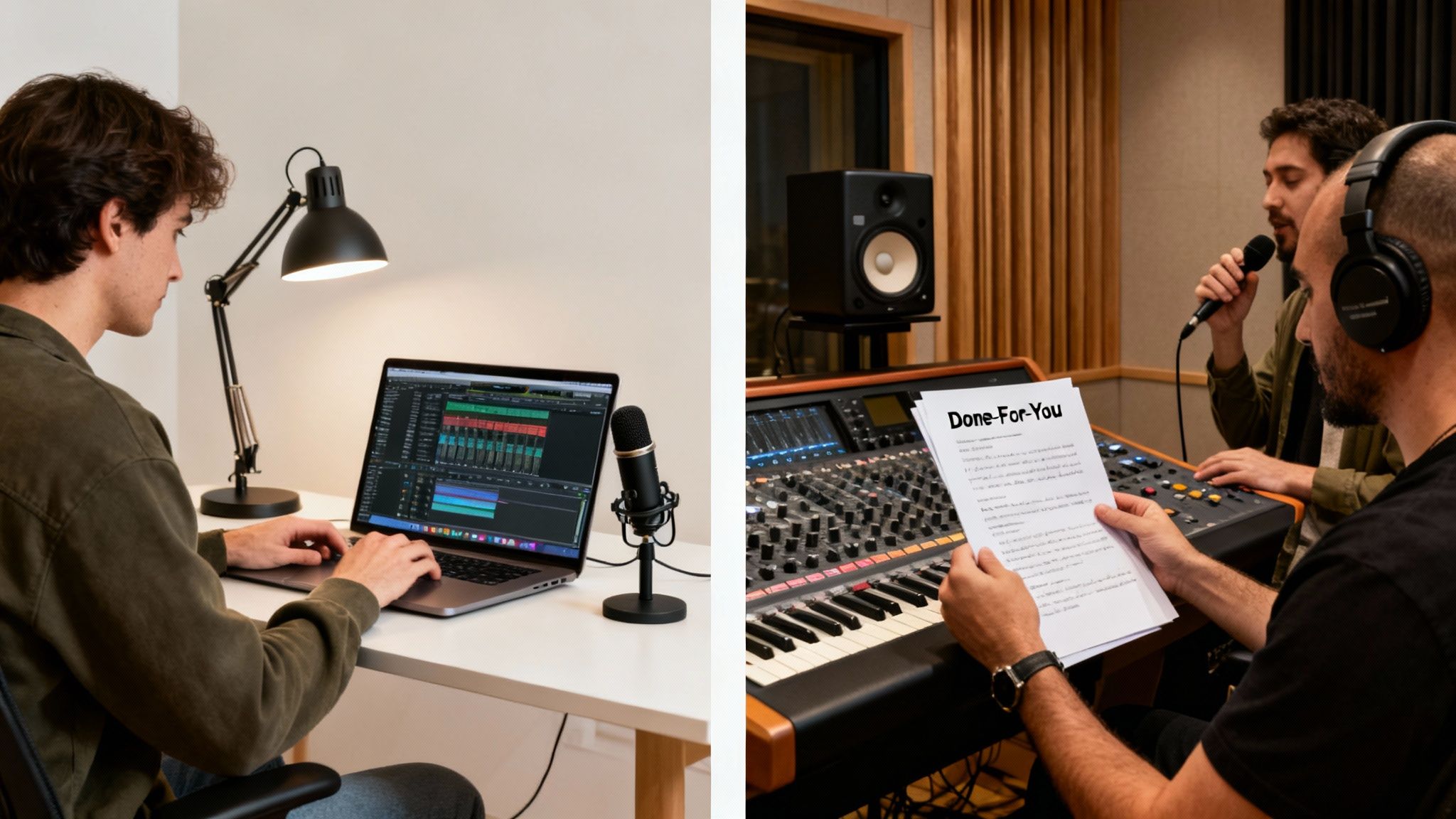
The Learning Path for DIY Creators
For the hands-on musician, producer, or tech enthusiast who loves a challenge, the DIY approach can be incredibly satisfying. If you’re already familiar with a Digital Audio Workstation (DAW), can sing fluently in the target language, and are curious about AI voice models, this path might be for you.
You’ll be responsible for everything:
- Musical Adaptation: Carefully rewriting the lyrics to fit the original melody, rhythm, and rhyme scheme. While general translation tools can offer a starting point, they rarely capture the artistic nuance needed for a song.
- Vocal Performance: Recording a clean, authentic vocal track.
- AI Voice Modeling: Getting up to speed on using and training AI voice models.
- Audio Production: Mixing and mastering the final track.
For those who want to learn the process themselves, resources like the AI Music Academy can teach you how multilingual lyric changes and AI voice models work. This path is perfect if you value the learning journey as much as the finished song.
The Done-For-You Path for Guaranteed Results
For most people, the goal is simple: a beautiful, professional-grade song without the steep learning curve. If you need a guaranteed, emotionally powerful result for a wedding, anniversary, or a corporate event, a professional change song lyrics service is the way to go.
This is the "done-for-you" path, where a team of experts handles every step. AI Music Service is a professional service that handles multilingual lyric changes end-to-end. We manage the entire human-crafted workflow for you:
- Your rewritten lyrics are adapted by experts to fit the song's melody.
- A real professional singer who is fluent in the target language performs them.
- Audio engineers apply advanced AI voice-matching so the performance sounds like the original artist.
- The track is professionally mixed over the original instrumental for a seamless, studio-quality finish.
AI Music Service works with a global network of international singers, selecting the right vocalist based on language, tone, and song style. Because this process involves specialized linguistic talent and extra production steps, a multilingual lyric change typically requires more work than standard lyric changes, but the result is a deeply personal and authentic song that connects powerfully with its audience.
Making The Right Decision For Your Project
Choosing how to change song lyrics into another language is a big deal, especially when it’s for something deeply personal. The path you take shapes everything—not just the final quality, but how the song feels. As we've seen, the gap between a quick DIY attempt and a professional production is huge.
The most common mistakes can strip a song of its soul: awkward phrasing from literal translations, amateur recordings that don't land, or robotic-sounding automated tools. A truly great multilingual version keeps the original magic alive while telling its story in a new language.
Weighing Your Options
So, how do you make the right choice? It really comes down to what you need for your specific project. Your decision will probably hinge on four key factors:
- Desired Quality: Do you need a seamless, studio-grade track that sounds like an official release?
- Technical Skill: Do you have experience with musical adaptation, vocal recording, and audio mixing?
- Timeline: Do you have the time to learn and manage a complex DIY process, or do you need a polished final product by a specific deadline?
- Emotional Impact: How important is it that the song feels authentic and emotionally powerful?
For anyone who wants a guaranteed, emotionally resonant outcome without the technical headaches, a professional lyric change service is the most reliable way to go. It ensures every single element—from the linguistic adaptation to the final mix—is handled with expert care. This approach is perfect for milestone events like weddings, anniversaries, and corporate celebrations where there’s no room for error.
When a project is meant to create a lasting memory, the reliability and polish of a professional, human-led process ensures your vision is brought to life perfectly.
If your goal is to transform a song you love into something uniquely yours, a professional service gives you peace of mind and an extraordinary result. It’s the surest way to honor the original track while creating a new version that speaks directly to the heart.
Ready to create an unforgettable musical moment? Start your project and change song lyrics into any language with our expert team today.
Got Questions? We've Got Answers
Thinking about turning a favorite song into another language brings up a lot of questions. It's a unique process, so let's clear up a few common ones.
Is This the Same as a Bilingual Cover Song?
Not at all. A cover song is a totally new interpretation—a different singer, often a different instrumental arrangement, and a completely fresh vibe. Nothing is a cover with our service.
A professional lyric change service is all about preserving the magic of the original. We keep the instrumental track exactly as you remember it and use sophisticated AI voice-matching to maintain the original singer's iconic voice. The final result isn't a new version; it's a deeply personal edition of the song you already love. Nothing is karaoke, and nothing is AI-generated from scratch.
Can You Really Change Any Song Into Any Language?
While it’s theoretically possible, some language combinations are far trickier than others. Every language has its own rhythm, cadence, and structure.
Imagine a short, punchy English lyric. In German, that same idea might need twice as many syllables, completely throwing off the song's flow. This is where the artistry comes in. A professional service focuses on musical adaptation, not just translation. Our expert linguists and songwriters work hand-in-hand to rewrite the lyrics so they fit the melody like a glove, making sure the song sounds smooth and authentic, not forced.
Why Does a Multilingual Lyric Change Cost More?
A multilingual lyric change is a much more hands-on, specialized process than a standard rewrite, and that extra investment goes into a few critical, human-led steps to get it just right.
Think of it as a full-scale vocal production. The process involves:
- Expert Linguistic Adaptation: This is far more than just running lyrics through a translator. It requires skilled songwriters to rewrite lyrics to fit the song's rhythm, rhyme scheme, and emotional tone.
- Finding a Native-Speaking Singer: To nail the pronunciation and performance, we source a professional vocalist who is a native speaker of the target language and can capture the original artist's style.
- Intensive Audio Engineering: Seamlessly blending new vocals in a different language into the original track is a complex task. Our engineers spend extra time on voice-matching and mixing to ensure the final blend is flawless.
Each of these steps adds a layer of craft and technical skill. It's what allows us to honor the original song while perfectly integrating the new language for an exceptional result.
At AI Music Service, we let people change the lyrics of a song they already love while preserving the original instrumental, the original melody, and the original singer’s voice. If you're ready to transform a beloved song into a different language for a truly unforgettable moment, we're here to bring your vision to life.
Ready to get started? Explore our professional lyric change service today.


